


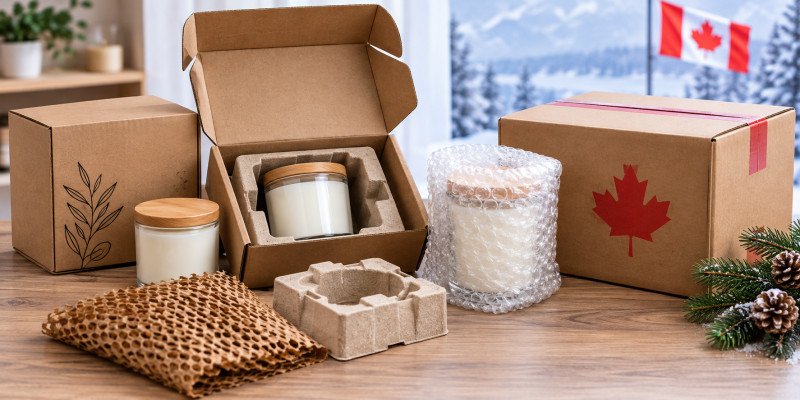
Use two boxes: printed custom candle boxes for presentation and a corrugated outer box for transit. Size the shipping box so the candle moves less than half an inch. Add candle box inserts to stop movement. When shipping candles in winter, let candles reach room temperature before packing, and use cold-temperature tape. In summer, avoid weekend transit so parcels are not sitting in hot trailers.
Can You Ship Candles in Canada? The Rules First
For most makers, yes. Solid wax candles are not restricted items, so they can be sent by mail or courier as long as they are packed properly so they do not melt or break in transit.
There are exceptions worth knowing before you ship candles in Canada:
- Gel candles, liquid-core candles, and candles with alcohol-based fragrance can fall under hazardous materials rules and may need declaration.
- Air shipping is often restricted or prohibited for candles that are classed as hazardous, while ground service is usually more flexible with proper labels and packaging.
- Fragrance and essential oils are treated differently from finished candles. Oils with a low flashpoint face air shipping restrictions of their own.
If you are unsure, ask your wax or fragrance supplier for a safety data sheet, and check the carrier's restricted items list before your first bulk run. Canada Post publishes its restrictions for both personal and business shipping.
What Actually Goes Wrong in Transit
Before choosing candle packaging, it helps to know the four failure modes that candle shipping boxes are built to prevent.
Glass breakage. Jar candles are dense, and a dropped parcel concentrates that weight on one corner of the glass.
Wax cracking. Cold makes wax contract and become brittle. Rough handling then produces hairline cracks across the surface.
Melting and warping. Wax is easily damaged by heat, which causes it to lose its shape and warp designs. Delivery trucks get very hot in summer, particularly without air conditioning.
Box crush. Candles are heavy for their size, so an undersized or thin-walled box collapses when parcels are stacked.
Good candle shipping boxes solve three of these four problems. The fourth, temperature, is about timing and insulation.
Step 1: Candle Shipping Boxes Come in Twos, Not Ones
The most common mistake is shipping a jar in a single mailer with some paper around it. Professional candle packaging uses two layers.
The product box is the printed box the customer sees. Tuck end custom candle boxes, rigid candle boxes, and window candle boxes all fall into this category. It protects the jar's surface, carries your branding, and holds the candle steady inside the outer carton.
The shipping box is the corrugated outer layer. Corrugated mailer boxes work well for one to three candles, while heavier multi-packs and wholesale orders need double-wall corrugated shipping boxes.
Corrugated shipping boxes suit fragile glass and tin candles, while mailers work for pillar candles and tea lights. If you sell a single jar candle, printed custom candle boxes inside corrugated mailer boxes are the reliable combination, and that pairing is the core of how to package candles for shipping without breakages.
Step 2: Size Your Candle Boxes Around the Jar
Fit matters more than padding. Select boxes that limit candle movement to under half an inch, especially for single-item shipments.
To size your custom candle boxes correctly:
- Measure the jar's outer diameter at its widest point, including any lip.
- Measure the height with the lid on.
- Add roughly 3 to 5 mm of clearance for a snug product box.
- For the outer candle shipping boxes, add 25 to 50 mm on each side for cushioning.
Here is a rough starting point for candle boxes for common jars. Always measure your own vessels, since jar shapes vary between suppliers.
| Candle size | Suggested packaging |
|---|---|
| 4 oz tin or jar | Small tuck end box, single mailer |
| 8 oz straight-sided jar | The most common retail size, usually a square product box |
| 12 to 16 oz jar | Taller product box with a reinforced base |
| Two-candle gift set | Divided candle boxes or a rigid box with an insert |
| Three or more candles | Corrugated mailer boxes with dividers |
Right-sizing is not only about protection. A smaller parcel costs less to ship, so the correct candle packaging pays for itself over a season.
Step 3: Add Candle Box Inserts That Hold the Jar
Inserts are what separate a professional shipment from a homemade one. Inserts fix the product in the packaging and stop it moving around the box, which is exactly what breaks glass.
Your options for candle box inserts:
- Cardboard inserts. The most affordable and the easiest to recycle. A die-cut collar holds the jar by its shoulder.
- Corrugated dividers. Best for multi-candle sets, since they stop jars colliding with each other.
- Moulded pulp inserts. Fully recyclable, with more cushioning than cardboard, and they suit heavier vessels.
- Foam inserts. The most protective candle box inserts, and worth it for luxury or high-value candles.
For multi-packs, dividers matter for a second reason. Candle wax melts at low temperatures, and packing scented candles tightly together increases the risk of them softening into each other and mingling scents.
Step 4: Wrap Each Candle Before It Goes in the Box
Wrap each candle in at least an inch of protective material such as kraft paper or tissue, then place it in its custom candle boxes. Individual wrapping protects the surface of the candle and isolates the scent so fragrances do not mingle in transit.
Fill any remaining space in the candle shipping boxes with paper, hex wrap, or biodegradable packing peanuts. Empty space is what allows movement, and movement is what breaks things.
Step 5: Winter Protection When Shipping Candles in Canada
This is the section other guides skip. Every international article warns about heat. Almost none address the Canadian reality of shipping candles in winter, when parcels sit in unheated trailers and on doorsteps in freezing temperatures, and candle packaging has to hold up in both directions.
Cold makes wax brittle
Wax contracts as it cools. A jar that goes from a heated studio into a minus 20 trailer contracts quickly, which produces surface cracks, frosting on soy candles, and sometimes wax pulling away from the glass. The candle still burns, but it looks damaged, and customers judge with their eyes.
Let candles acclimatise before packing
Do not pack candles straight from a cold garage or an unheated storage unit. Let them sit at room temperature for several hours first, so the wax and glass are at a stable temperature when they are sealed in.
Watch out for thermal shock on glass
Rapid temperature change stresses glass. A frozen jar brought into a warm home can crack. Add a short care note printed inside your custom candle boxes telling customers to let the candle reach room temperature before lighting it in winter. It costs nothing and prevents complaints.
Use cold temperature tape
Standard packing tape loses tack in the cold, which is why seams pop open in January. Cold temperature box sealing tapes use adhesives designed for this: 3M's cold temperature tapes can be applied at freezer and refrigeration temperatures of roughly -6.6°C to 10°C and keep holding well below freezing. If your packing area is a cold warehouse, this single change prevents a lot of damaged parcels.
Add insulation to candle shipping boxes for long hauls
For shipments to northern communities or across the Prairies in deep winter, add a layer of insulated liner or thicker cushioning. It slows the temperature swing inside the candle boxes, which is what causes cracking.
Summer: How to Ship Candles Without Melting the Wax
The opposite problem arrives in July. Soy wax generally melts around 45°C to 55°C, and paraffin in the range of 46°C to 68°C, depending on the blend. A closed delivery van in an Ontario heatwave can reach those numbers.
Practical steps:
- Ship early in the week so parcels are not sitting in a hot depot over the weekend.
- Choose faster services in heatwaves, since less transit time means less heat exposure.
- Add gel packs or thermal liners inside the candle boxes for premium orders.
- Do not freeze candles before shipping. Freezing can crack and warp wax as badly as heat does.
Step 6: Seal, Label and Choose the Right Service
Seal your candle shipping boxes with tape on both ends, then mark them clearly. Fragile and Do Not Stack labels reduce the chance of heavy parcels being piled on top of your candles.
Add tracking for anything valuable, and consider insurance for gift sets and wholesale pallets. For breakage claims, photographs of your packing process help.
What It Costs, and How to Spend Less
Candle packaging costs add up across a season, so a few decisions matter:
- Right-size everything. Oversized parcels cost more to ship and use more filler.
- Order custom candle boxes flat-packed. They store easily and cost less to ship to you.
- Standardise your candle boxes. One size that fits two of your jars beats two separate runs.
- Buy in larger quantities. Per-unit pricing drops sharply with volume, as our guide to custom box costs in Canada explains.
Candle Packaging Ideas That Also Protect the Product
Protection and presentation are not opposites. A few candle packaging ideas that do both:
- Kraft boxes with a die-cut collar insert: eco-friendly, and the collar is what holds the jar.
- Rigid candle boxes with moulded inserts: premium unboxing, excellent protection for two-candle sets.
- Window boxes with a recessed insert: shoppers see the wax colour while the jar stays secure.
- Printed corrugated mailer boxes: branding on the outside, protection built in, ideal for direct-to-customer orders.
- Interior printing with burn instructions: useful content on a surface you are already paying for.