


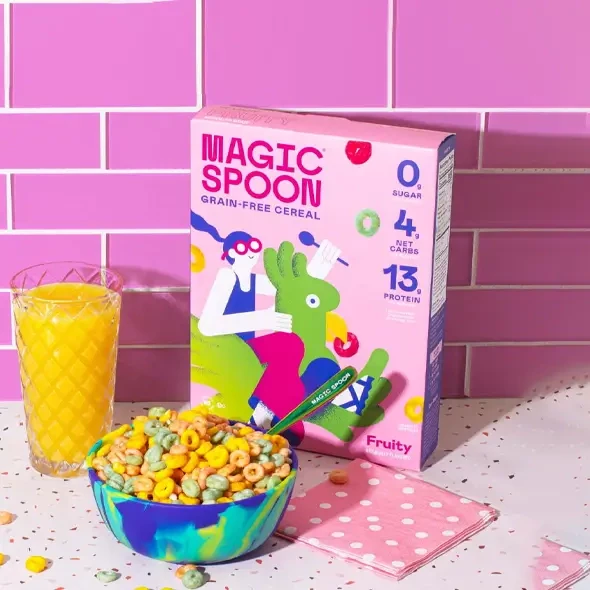

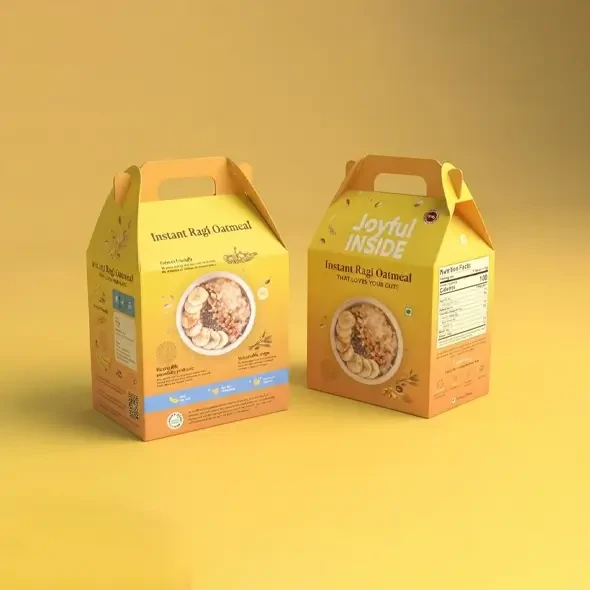
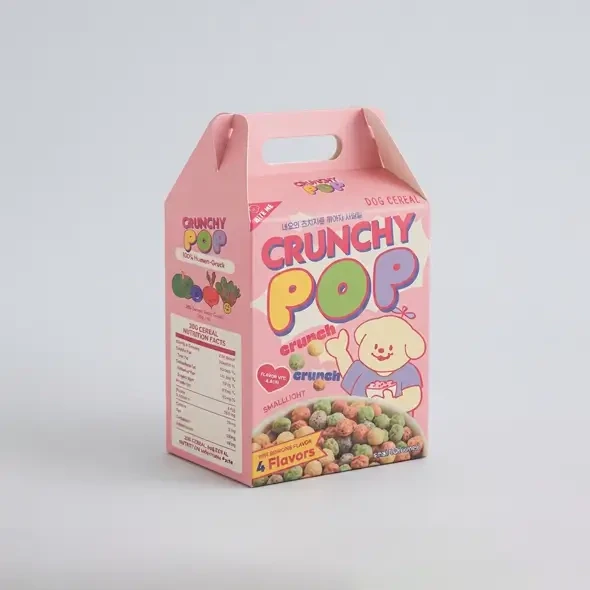
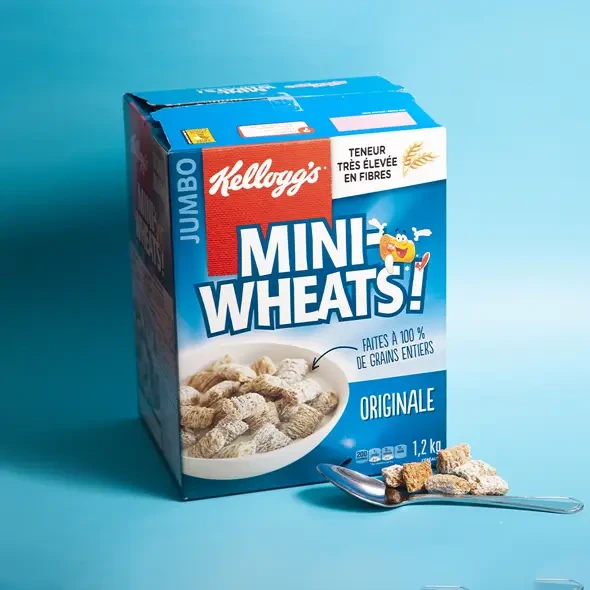
| Box Style | As Mention Above |
|---|---|
| Dimension (L + W + H) | All Custom Sizes & Shapes |
| Minimum Run ( For Boxes and Mylar Bags) | 100 Boxes - 1000 Mylar Bags ( 500 each design) |
| Paper Stock | 10pt to 28pt (60lb to 400lb) Eco-Friendly Kraft, E-flute Corrugated, Bux Board, Cardstock |
| Printing | No Printing, CMYK, CMYK + 1 PMS color, CMYK + 2 PMS colors |
| Finishing | Gloss Lamination, Matte Lamination, Gloss AQ, Gloss UV, Matte UV, Spot UV, Embossing, Foiling |
| Included Options | Die Cutting, Gluing, Scored,Perforation |
| Additional Options | Eco-Friendly, Recycled Boxes, Biodegradable |
| Proof | Flat View, 3D Mock-up, Physical Sampling (On request) |
| Turnaround | 7 - 8 Business Days |
| Shipping | FLAT Position |
Custom Cereal Boxes Carton Sells It the Liner Keeps It
Here's the thing most packaging suppliers won't tell you: a cereal carton does not keep cereal fresh. Paperboard is porous. Left to itself, a printed carton lets moisture in within days, and crisp cereal turns leathery long before the printed best-before date.
What keeps cereal fresh is the inner bag a barrier film liner sitting inside the carton. The carton's job is structural and commercial: hold the shape, survive the pallet, carry the nutrition panel, and win the two-second glance in the breakfast aisle.
Get either component wrong and the product fails. A beautiful box with a weak liner sells once. A great liner in a flimsy carton arrives crushed. CustomBoxesZone builds custom cereal boxes as a complete system carton and liner specified together from a minimum order of 50, with free design and free shipping across Canada.
What Are Custom Cereal Boxes?
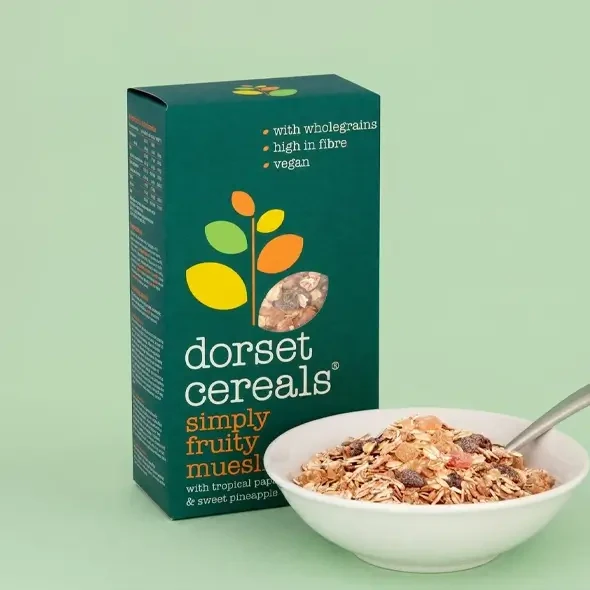
Custom cereal boxes are tall, narrow folding cartons made to your fill volume, paired with a barrier film liner that protects the cereal from moisture and oxygen. The carton is typically 16–24pt SBS or recycled paperboard with a straight tuck or auto-lock construction, printed on the outside for retail shelf impact and carrying the mandatory nutrition and ingredient information.
The Barrier Question Which Liner Your Cereal Needs
Cereal fails through moisture ingress. Different products fail at different speeds.
| Liner type | Barrier level | Best for |
|---|---|---|
| OPP film | Basic moisture barrier | Fast-turn cereals, short supply chains, single-serve |
| BOPP, heavier gauge | Good moisture barrier | Standard flakes, puffed cereal, family-size retail |
| Metallised film | Strong moisture and light barrier | Granola with nuts and oils, longer shelf life |
| Foil laminate | Highest moisture, oxygen and light barrier | High-fat granola, freeze-dried inclusions, export |
| Resealable zip liner | Same barrier, plus reclosure | Premium and DTC brands a genuine purchase driver |
The practical rule: the more fat in your cereal, the more barrier you need. A plain corn flake is forgiving. Granola loaded with nuts, seeds, and coconut oil goes rancid through oxygen ingress long before it goes soft that product needs metallised or foil, not OPP.
Resealability is worth paying for. Consumers cite stale cereal as the top complaint in the category, and it's almost always caused by a torn bag that no longer closes. A zip liner adds a small unit cost and removes the main reason people don't repurchase.
We also produce liner-free barrier-coated cartons for dry, low-fat products in fast retail turnover fewer components, fully recyclable, but only appropriate where shelf life demands are modest. We'll tell you honestly which side of that line your product sits on.
Every Cereal Format We Produce
Custom Cereal Boxes (Standard Retail)
The classic tall carton. Straight tuck end or auto-lock bottom, 16–20pt board, printed CMYK across all five visible panels. The structural point: cereal cartons are tall and thin, which makes them prone to bowing under their own fill weight and to crushing when stacked. Board caliper is specified against fill weight, not against box dimensions a 1kg granola box needs meaningfully heavier board than a 350g flake box of identical size.
Custom Mini Cereal Boxes
Single-serve portions for hotels, airlines, school programmes, catering, variety packs, and promotional giveaways. Why brands order them: they're the cheapest trial mechanism in food. A mini box puts your product in someone's hands with no purchase decision attached. Available in square, rectangular, and die-cut shapes, with the same liner options scaled down.
Family-Size and Value Cereal Boxes
Larger fill volumes, 750g to 1.2kg. The structural point: this is where board specification stops being optional. A family box that bows on shelf reads as cheap and damaged, and a bowed box loses its facing to the neighbouring brand.
Granola and Muesli Boxes
Higher fat content, heavier product, chunkier pieces. The technical point: granola settles and compacts during transit, so fill height at packing looks different from fill height at shelf. We size the carton to the settled volume, not the packed volume, so customers don't perceive an underfilled box. Metallised or foil liner recommended.
Oatmeal and Porridge Boxes
Often sachet-based rather than loose. The structural point: sachet counts are the sizing driver here, not volume we build the carton around your sachet dimensions and count, with an internal fit tight enough that sachets don't shift.
Protein, Keto and Functional Cereal Boxes
The fastest-growing segment in the category. The technical point: these products carry a much heavier text load protein per serving, net carbs, ingredient sourcing, and often certification marks. Panel hierarchy has to be planned before the graphics, or the claims that actually sell the product end up squeezed under the barcode.
Window Cereal Boxes
Die-cut aperture with food-safe film, letting shoppers see the product. Best for: premium granola and muesli where the product itself looks appetising. A window is a barrier weakness, so pair it with a strong inner liner.
Single-Serve Cups and Bowls
Grab-and-go format for convenience retail and workplace catering.
Blank and Plain Cereal Boxes
Unprinted stock cartons for brands that apply their own labels or for R&D and shelf-testing. Genuinely useful for: validating a size and facing on a real shelf before committing to print.
Cereal Subscription Mailers
Direct-to-consumer cereal is growing fast, and it breaks the normal rules. A retail carton is not a shipper it'll arrive scuffed and dented. We build DTC cereal packaging as either an E-flute mailer sized to your carton or as a self-shipping corrugated carton with printed interior.
Kids' and Character Cereal Boxes
Bright, character-led artwork with back-of-box games and puzzles. One important caution: you cannot legally print licensed characters Disney, Nintendo, Marvel, or any recognisable IP without a licence from the rights holder. Some suppliers actively advise using popular cartoon characters. Don't. We'll happily print original characters you own or have commissioned, and we'll flag anything in your artwork that looks like a licensing risk before we go to plate.
Cereal Box Sizes and Fill Volumes
Sizes are fully custom, but these are the formats most commonly ordered.
| Format | Typical fill | Box size (H × W × D) |
|---|---|---|
| Mini / single-serve | 25–40 g | 3.5" × 2.5" × 1.25" |
| Small retail | 200–300 g | 8.5" × 6" × 2" |
| Standard retail | 350–500 g | 11" × 7.5" × 2.5" |
| Large retail | 500–750 g | 12" × 8" × 3" |
| Family size | 750 g–1 kg | 13" × 9.5" × 3.25" |
| Value / club size | 1–1.5 kg | 14" × 10" × 4" |
| Granola (denser) | 400 g | 9" × 6.5" × 3" |
| Oatmeal sachet box (10ct) | - | 8" × 6" × 3" |
Sizing rule: size to settled volume, not packed volume. Cereal compacts are 8–15% in transit. A box that looks generously full at the filling line looks half-empty on the shelf if you size to the wrong number.
Winning the Breakfast Aisle
Cereal is the most planogram-driven category in grocery, and packaging decisions are shelf decisions.
Facing width is your billboard. A wider, shallower box gets more front-facing surface for the same volume than a narrow, deep one. It costs slightly more in board and takes more shelf depth allocation but if you're fighting for attention against established brands, width buys you visibility.
Vertical positioning drives the design. Kids' cereals sit low, at children's eye level, which is why character art and bright colour work there. Adult health and premium cereals sit at adult eye level, where clean typography, ingredient callouts, and matte finishes perform better. Design for the shelf height you'll actually be given.
The two-second rule. Shoppers scan a cereal aisle at roughly two seconds per facing. Your product name and category descriptor need to be legible from a metre away. The most common design failure we see is beautiful artwork with a product name too small to read at shelf distance.
Back-of-box real estate. Games, puzzles, recipes, brand story, QR codes to content. It's free advertising space already paid for, and it's the panel most brands leave nearly blank.
Crush resistance. Boxes are stacked on pallets and jostled by restockers. Specify board against pallet load, and consider an auto-lock bottom over a tuck-in for heavier fills.
Canadian Labelling Including the New Front-of-Pack Symbol
Cereal carries one of the heaviest label loads in packaged food. Plan panel space structurally at the die-line stage.
- Bilingual English and French for all mandatory information
- Nutrition Facts / Valeur nutritive table, bilingual or side-by-side
- Front-of-package nutrition symbol Health Canada's magnifying-glass symbol is required on prepackaged foods meeting or exceeding thresholds for saturated fat, sugars, or sodium. Breakfast cereal is one of the most commonly affected categories. The symbol occupies a defined, protected area in the upper-right portion of the principal display panel, at a specified minimum size. If your product triggers it, that space is not available for your artwork, and finding that out at the proofing stage means redesigning the entire front panel. Confirm your product's status with your own regulatory advisor, and tell us at briefing so we can reserve the area from the start.
- Ingredient list in descending order by weight, bilingual
- Allergen and "may contain" declarations: wheat, nuts, soy, milk
- Net quantity in metric
- Nutrient content and health claims: "source of fibre" "whole grain" and "gluten-free", each with its own compositional criteria
- Barcode placement and quiet zones are common causes of reprints when they are placed over a fold or crease
Practically, a Canadian cereal box needs roughly 40–60% more legible text area than the US equivalent, plus reserved symbol space. This is where projects go wrong at the last minute, and where planning early saves the most money.
Materials and Sustainability
| Material | Best for | Key property |
|---|---|---|
| 16–20pt SBS paperboard | Standard retail cartons | Bright white print surface, clean creasing |
| Recycled CRB / CCNB | Cost-focused volume runs | Economical, high recycled content |
| Kraft board | Organic, artisan granola | Natural finish, curbside recyclable |
| E-flute corrugated | DTC shippers, club-size | Crush protection |
| Barrier-coated board | Liner-free short-shelf-life products | Integrated moisture resistance |
On recycled board and food contact: recycled paperboard can carry mineral oil residues that migrate into dry foods over long shelf lives. Where recycled content is used in a cereal carton, we specify either a functional barrier liner or a barrier coating. This matters more for products with long shelf lives and high surface area which describes cereal exactly.
FSC-certified stock, soy-based low-migration inks, and recyclable mono-material constructions are available across the range. Note honestly that a metallised or foil liner is not curbside recyclable in most Canadian municipalities if full recyclability is your priority, we'll build toward a paper-based barrier and tell you what shelf life you're trading away.
Printing and Finishing
Printing: offset CMYK for volume runs, digital for short runs and flavour variants, plus up to 2 PMS spot colours. Cereal brands live or die on colour consistency across a range if you have six flavours on one shelf, they need to read as one family, which means spot colour for your brand base.
Finishes: gloss lamination, matte lamination, aqueous coating, gloss and matte UV, spot UV, foil stamping, embossing and debossing.
What works in this category: aqueous or gloss for mainstream and kids' cereals colour saturation is the whole game there. Matte with a spot-UV logo for premium granola and health positioning. Kraft with two-colour print for organic and bean-to-bowl brands. Avoid heavy lamination on any panel where a best-before date will be inkjet-coded; the ink won't adhere cleanly.
Ordering in Five Steps
- Send your specs fill weight, product type and fat content, format, and quantity.
- Free quote in 24 hours, with a carton and liner recommendation.
- Free design die-line and 3D mock-up at no cost, with bilingual and front-of-pack symbol space planned in.
- Sample it physical samples on request, so you can fill a real box and check settled fill height and shelf presence.
- Production and delivery 8–12 business days standard, 4–6 rush, free shipping across Canada.
Specifications
| Specification | Details |
|---|---|
| Minimum order | 50 boxes |
| Sizes | Fully custom (H × W × D), any fill volume |
| Stock | 10pt–28pt SBS, recycled CRB, kraft, E-flute corrugated, barrier-coated |
| Liners | OPP, BOPP, metallised, foil laminate, resealable zip |
| Printing | CMYK, CMYK + 1–2 PMS, digital, offset |
| Finishing | Gloss/matte lamination, AQ, UV, spot UV, foiling, embossing |
| Add-ons | Windows, auto-lock bottoms, perforated pour spouts, QR codes |
| Food safety | Food-contact-approved board, low-migration soy inks |
| Eco options | FSC-certified, recycled, kraft, recyclable mono-material |
| Proofing | Flat view, 3D mock-up, physical sample on request |
| Turnaround | 8–12 business days standard, 4–6 rush |
| Shipping | Free across Canada, delivered flat |
Serving Cereal and Granola Brands Across Canada
We ship free to every province and territory, with regular orders from Toronto, Mississauga, Ottawa, Montreal, Vancouver, Surrey, Calgary, Edmonton, Winnipeg, Saskatoon, and Halifax. Canada's independent granola and muesli scene is one of our busiest segments, with small-batch brands moving from bagged product into retail-ready cartons for the first time.
Cartons ship flat and pre-glued, which cuts freight volume sharply and stores compactly, a real consideration for producers working out of shared kitchens or small warehouse space.
Start Your Cereal Packaging Project
Send us your fill weight, product type, and rough annual volume. We'll come back within 24 hours with a carton spec, a liner recommendation matched to your fat content and target shelf life, a free die-line, and a quote. No setup fees, no die charges.


