


| Box Style | As Mention Above |
|---|---|
| Dimension (L + W + H) | All Custom Sizes & Shapes |
| Minimum Run ( For Boxes and Mylar Bags) | 100 Boxes - 1000 Mylar Bags ( 500 each design) |
| Paper Stock | 10pt to 28pt (60lb to 400lb) Eco-Friendly Kraft, E-flute Corrugated, Bux Board, Cardstock |
| Printing | No Printing, CMYK, CMYK + 1 PMS color, CMYK + 2 PMS colors |
| Finishing | Gloss Lamination, Matte Lamination, Gloss AQ, Gloss UV, Matte UV, Spot UV, Embossing, Foiling |
| Included Options | Die Cutting, Gluing, Scored,Perforation |
| Additional Options | Eco-Friendly, Recycled Boxes, Biodegradable |
| Proof | Flat View, 3D Mock-up, Physical Sampling (On request) |
| Turnaround | 7 - 8 Business Days |
| Shipping | FLAT Position |
Custom Chocolate Boxes Built Around a Fragile Product
Chocolate is the hardest confection to package well. It softens at 26°C, blooms if the temperature swings, absorbs odours straight through unlined board, scuffs against its own neighbours, and because it's overwhelmingly bought as a gift, is judged on presentation before anyone tastes it.
Most packaging suppliers treat a chocolate box as a print job. It isn't. It's a small food-preservation problem with a gift-wrapping problem stacked on top of it, and the boxes that win on the shelf solve both.
CustomBoxesZone builds custom chocolate boxes for both barrier-grade food-safe materials and insert systems engineered to your exact piece count and finishing that reads as premium in a customer's hands. MOQ of 50, free design, free shipping across Canada.
What Are Custom Chocolate Boxes?
Custom chocolate boxes are food-safe paperboard or rigid containers made to your product's exact dimensions and piece count, with inserts that immobilise each chocolate and barrier properties that protect against moisture, odour, and temperature. They differ from stock confectionery boxes in three ways: the cavity layout matches your specific mould, the board is specified for chocolate's particular sensitivities, and the print and finish carry your brand rather than a generic gift motif.
Every Chocolate Format We Package
Slim tuck-end cartons or wrap-around sleeves for single-origin bars, craft tablets, and protein bars. The technical point: bars are flat and rigid, so the risk isn't crushing it's the box flexing and snapping the bar at the score lines. We spec board stiffness against bar length, and for bars over 100g we recommend a rigid backer or a slightly deeper carton with a supporting fold.
Custom Truffle Boxes
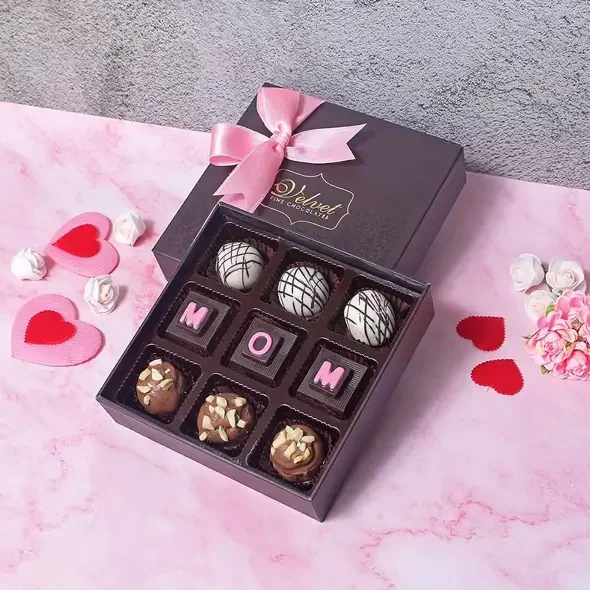
Two-piece or tuck-top boxes with fitted cavity trays for 4, 6, 9, 12, or 24 pieces. The technical point: truffles are soft-centred and often dusted or enrobed. Cavity depth has to clear the truffle without letting it rattle, and the tray surface has to be smooth enough not to abrade a cocoa-dusted shell. We specify cavity dimensions to your actual mould, not a standard.
Custom Bonbon Boxes
Precision-cavity boxes for moulded, shell-tempered bonbons, the highest-value pieces most chocolatiers make. The technical point: polished bonbons show fingerprints and scuffs instantly. Cavities need to hold each piece with zero lateral movement, because a bonbon that slides even 2mm arrives with a scuffed shell and looks like a second.
Turtle Chocolate Boxes
Sized for the irregular, domed profile of caramel-pecan turtles. The technical point: turtles are uneven in height and stickier than most confections. We build deeper cavities with slightly generous tolerances and recommend a greaseproof liner, because caramel migration into raw board is a real and visible problem.
Cocoa Bomb Boxes
Spherical-cavity boxes for hot chocolate bombs. The technical point: cocoa bombs are hollow spheres, the most fragile item in the entire confectionery category. They crack under almost no pressure. We build these with deep individual spherical wells, soft cushioning, and a lid that cannot press down onto the sphere crown. This is a product where the insert matters more than the box.
Window Chocolate Boxes
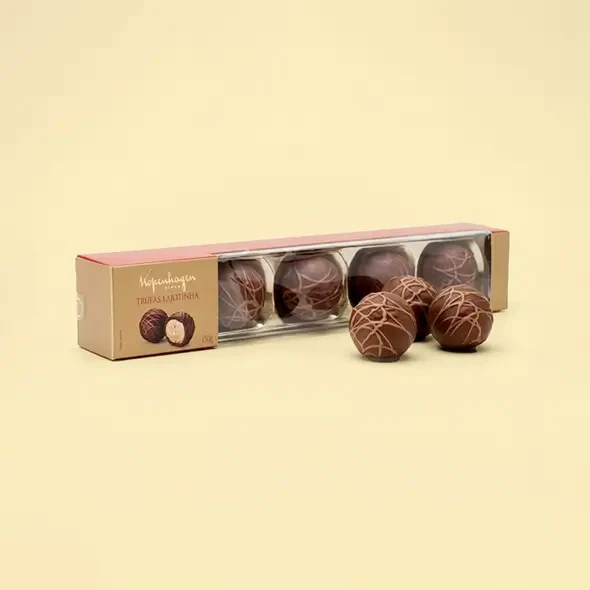
Die-cut apertures with food-safe PET or PVC film. The technical point: Windows sell customers buy chocolate they can see, but a window is a thermal and light weakness. We keep the aperture proportionate and recommend it for chilled, climate-controlled, or fast-turn retail rather than long-shelf or warm-weather distribution.
Rigid Chocolate Gift Boxes
Lid-and-base or magnetic-closure rigid construction for luxury assortments and corporate gifting. The technical point the rigid board is wrapped, not printed directly, so colour matching happens on the wrap. It's the most premium option in the range and the one that photographs best.
Drawer Style and Sleeve Boxes
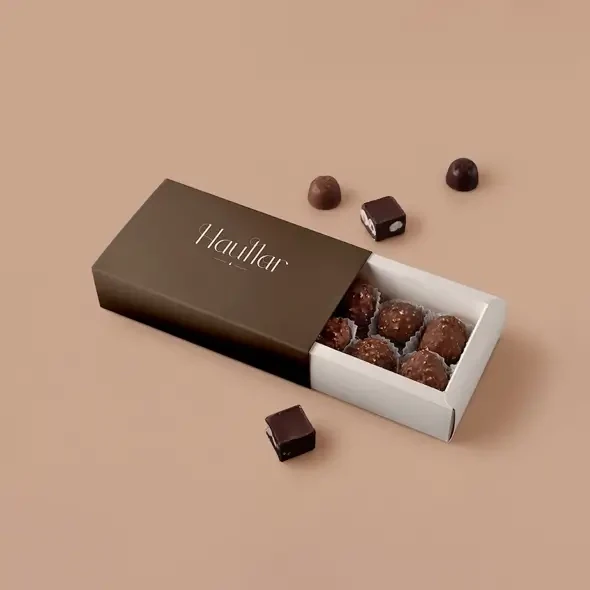
A sliding inner tray with a ribbon pull, or an outer sleeve over a base tray. Best for: brands where the opening ritual is part of the product story.
Chocolate Display Boxes
Counter-ready open-front or tray displays for point-of-sale. Best for: cafes, delis, and grocery checkouts where impulse purchase is the whole business model.
Mushroom Chocolate Bar Packaging
Functional-mushroom chocolate bars with lion's mane, reishi and cordyceps are one of the fastest-growing categories in the range. The technical point: these products carry more mandatory copy than standard chocolate, including ingredient sourcing, serving guidance, and cautions. Panel layout has to be planned around that text load before the graphics are designed, and any health-related claims need to clear your own regulatory review before we go to plate.
The Chocolate-Specific Problems Nobody Else Writes About
When chocolate warms past roughly 26°C and re-cools, cocoa butter migrates to the surface and re-crystallises as a grey-white film. The product is perfectly edible and looks spoilt.
Packaging can't refrigerate your product, but it can slow the swing. Corrugated flute walls buffer temperature change measurably better than flat cardstock; the trapped air in the flute acts as insulation. For summer shipping across Canada, and for anything moving through a non-climate-controlled warehouse, we recommend an E-flute outer shipper around the retail carton. It's a small cost against the return rate on a bloomed shipment.
Odour and taint migration
This is the one that quietly ruins products. Chocolate is highly lipophilic it absorbs volatile compounds from its surroundings, including from the board it sits in. Recycled paperboard can carry mineral oil residues (MOSH and MOAH) from printing inks in its previous life, and those migrate into fatty foods.
Our approach: virgin food-grade board for direct-contact applications, functional barrier layers where recycled content is used, and low-migration ink systems throughout. If you want recycled stock for sustainability reasons, a legitimate goal, we'll specify it with a barrier liner rather than pretending the issue doesn't exist. Most suppliers won't raise this with you at all.
Moisture and sugar bloom
Condensation on a chocolate surface dissolves sugar, which then recrystallises as a gritty white layer. This is why chocolate should never be moved rapidly between cold and warm without acclimatisation. Barrier-coated board and a properly closed carton both help.
Scuffing and piece movement
The most common complaint we hear from chocolatiers isn't melt it's arrival condition. Pieces that shift abrade each other. The fix is cavity engineering, not a stronger board.
Insert Systems and Piece-Count Sizing
Tell us your piece dimensions and count; we engineer the tray. As a starting reference:
| Piece count | Layout | Typical box size (L × W × H) |
|---|---|---|
| 4 pieces | 2 × 2 | 3.5" × 3.5" × 1.25" |
| 6 pieces | 3 × 2 | 5" × 3.5" × 1.25" |
| 9 pieces | 3 × 3 | 5" × 5" × 1.25" |
| 12 pieces | 4 × 3 | 6.5" × 5" × 1.25" |
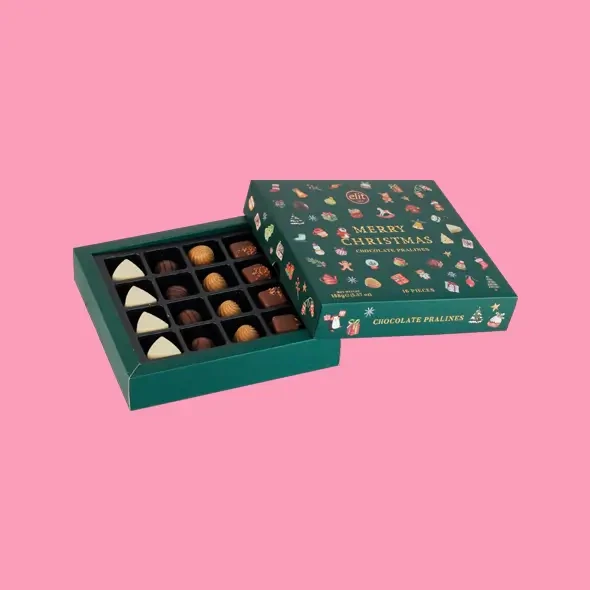
| 16 pieces | 4 × 4 | 6.5" × 6.5" × 1.25" |
| 24 pieces | 6 × 4 | 9.5" × 6.5" × 1.25" |
| Single bar (100g) | — | 6" × 3" × 0.5" |
| Cocoa bomb (single) | — | 3" × 3" × 3" |
| Cocoa bomb (4-pack) | 2 × 2 | 6" × 6" × 3" |
Insert options: die-cut paperboard cavity trays, vacuum-formed food-grade PET trays, corrugated dividers for bars, moulded pulp trays for eco-first brands, foam beds for high-value rigid sets, and satin or ribbon base layers for luxury presentation.
Materials
| Material | Best for | Key property |
|---|---|---|
| 14–18 pt coated paperboard | Retail bars, truffle boxes | Lightweight, sharp print, food-safe |
| E-flute corrugated | Shipping-and-retail hybrid, summer transit | Impact protection, thermal buffering |
| Rigid chipboard (1200–2000 gsm) | Luxury assortments, corporate gifting | Structural rigidity, premium hand-feel |
| Kraft board | Artisan, bean-to-bar, organic brands | Natural finish, curbside recyclable |
| Barrier-lined board | Caramel, ganache, high-fat fillings | Blocks grease and odour migration |
All materials are food-contact-safe and meet Canadian Food Inspection Agency and FDA indirect-food-contact requirements. Inks are soy-based, low-migration, and certified non-toxic.
Printing and Finishing
Printing: offset CMYK for volume, digital for short runs and seasonal versions, plus up to 2 PMS spot colours. Chocolate brands lean heavily on a signature colour; if yours has to be identical across a bar carton, a truffle box, and a gift set, spot colour is the only reliable route.
Finishes: matte, gloss, and soft-touch lamination; aqueous coating; gloss and matte UV; spot UV; hot foil stamping in gold, silver, copper, or holographic; embossing and debossing; white ink for kraft and dark stocks.
What actually works in confectionery: soft-touch with foil-stamped type is the most reliable premium signal in the category — it feels expensive before the box opens. Matte with spot UV on the logo is the value version of the same effect. High gloss across the whole box reads as mass-market, which is fine if that's your position and wrong if it isn't.
Inner lid printing is the most underused tool in chocolate packaging. A flavour map, a tasting note, the origin of the beans, or a short brand story printed inside the lid costs almost nothing and is the single most photographed part of a premium chocolate box.
Canadian Labelling Considerations
Chocolate sold at retail in Canada carries a heavier label load than most confections. Plan for it structurally, not at the proofing stage.
- Bilingual English and French for all mandatory information under the Consumer Packaging and Labelling Act
- Nutrition Facts / Valeur nutritive table bilingual or two side-by-side panels, which consumes real estate fast
- Allergen declaration milk, soy lecithin, nuts, and "may contain" cross-contamination statements
- Ingredient list in descending order by weight, bilingual
- Net quantity in metric
- Cocoa percentage and origin claims, where used
Practically, a Canadian chocolate carton needs roughly 40–60% more legible text area than its US equivalent. We plan a panel hierarchy at the die-line stage so you're never squeezing a bilingual nutrition panel into 5pt type at the last minute.
Seasonal Packaging and Lead Times
Chocolate is a seasonal business. Roughly 70% of category sales cluster around five windows: Valentine's Day, Easter, Mother's Day, Halloween, and Christmas.
The practical advice most suppliers won't give you: order seasonal packaging one full quarter ahead. Board mills and print schedules tighten severely in September–November as everyone chases Christmas. A Valentine's run ordered in early January is a rush job; ordered in November, it's routine and cheaper.
Seasonal tooling isn't required. We update your existing die-line with new artwork each occasion, which keeps your unit cost flat while the packaging stays fresh: Valentine's blush and foil, Christmas sleeves over your standard base, pastel Easter colourways, corporate logo assortments, and small wedding favour boxes with names or dates.
Sustainability
FSC-certified paperboard from responsibly managed forests, recyclable and compostable kraft options, soy-based and low-migration inks, biodegradable lamination alternatives to conventional plastic film, and moulded pulp inserts in place of PET trays.
A word of honesty: PET insert trays are the least sustainable component of most chocolate boxes, and they're also the ones that protect fragile pieces best. Moulded pulp and die-cut paperboard trays are recyclable alternatives that work well for firmer pieces and bars. For delicate bonbons and cocoa bombs, PET is often still the right call we'll tell you which trade-off you're making rather than greenwashing it.
Wholesale Ordering
Ordering chocolate boxes wholesale lowers unit cost through amortised setup, volume board pricing, and consolidated freight. Tiered pricing drops meaningfully at 1,000, 5,000, and 10,000 units.
But our minimum is 50 boxes. A boutique chocolatier launching a Valentine's assortment shouldn't have to commit to a pallet to find out whether the design works. Start small, prove it, and scale into volume pricing.
Ordering in Five Steps
- Send your specs: piece dimensions, count, format, and quantity.
- Free quote in 24 hours with a material and insert recommendation.
- Free design die-line and 3D mock-up at no cost; bilingual layout planned in.
- Sample it physical samples on request, so you can load real pieces and check cavity fit before committing.
- Production and delivery: 8–12 business days standard, 4–6 rush, free shipping across Canada.
Specifications
| Specification | Details |
|---|---|
| Minimum order | 50 boxes |
| Sizes | Fully custom (L × W × H), any shape |
| Stock | 10 pt–28 pt cardstock, kraft, E-flute corrugated, rigid chipboard, barrier-lined |
| Printing | CMYK, CMYK + 1–2 PMS, digital, offset, white ink |
| Finishing | Matte/gloss/soft-touch lamination, AQ, UV, spot UV, foiling, embossing, debossing |
| Inserts | Paperboard cavity trays, PET trays, moulded pulp, corrugated dividers, foam, satin |
| Add-ons | Windows, magnetic closure, ribbon pull, inner lid printing, sleeves |
| Food safety | Food-contact-approved board, low-migration soy inks |
| Eco options | FSC-certified, recycled, kraft, compostable, pulp inserts |
| Proofing | Flat view, 3D mock-up, physical sample on request |
| Turnaround | 8–12 business days standard, 4–6 rush |
| Shipping | Free across Canada, delivered flat |
Serving Chocolatiers Across Canada
We ship free to every province and territory, with regular orders from chocolate makers in Toronto, Mississauga, Ottawa, Montreal, Quebec City, Vancouver, Victoria, Calgary, Edmonton, Winnipeg, Saskatoon, and Halifax. Quebec's craft chocolate scene in particular orders heavily from us and it's the region where bilingual panel planning saves the most rework.
Boxes ship flat and pre-glued, which cuts freight volume sharply and stores in a fraction of the back-of-house space. For summer deliveries into warmer regions, ask about insulated outer shippers.
Start Your Chocolate Packaging Project
Send us your piece dimensions, your count, and roughly how many boxes you go through a season. We will come back within 24 hours with a format recommendation, an insert layout, a free die-line, and a quote. No setup fees, no die charges.


