


When businesses invest in professional printing, they often focus on the design, colours, and paper quality but overlook one important decision: the lamination finish.
The choice between gloss and matte lamination can significantly change how your printed materials look, feel, and perform over time. A restaurant menu, business card, brochure, product label, or presentation folder does not only represent your information; it represents your brand.
In Canada, this decision becomes even more important because businesses operate in different environments. Printed materials may be exposed to moisture, frequent handling, changing temperatures, and different lighting conditions. A finish that works perfectly for a luxury real estate brochure may not be the best option for a busy restaurant menu.
For example, a café owner may want a menu that can be cleaned easily after every customer use, while a financial consultant may want a business card that feels premium and professional when handed to clients.
This is where gloss and matte lamination create different advantages.
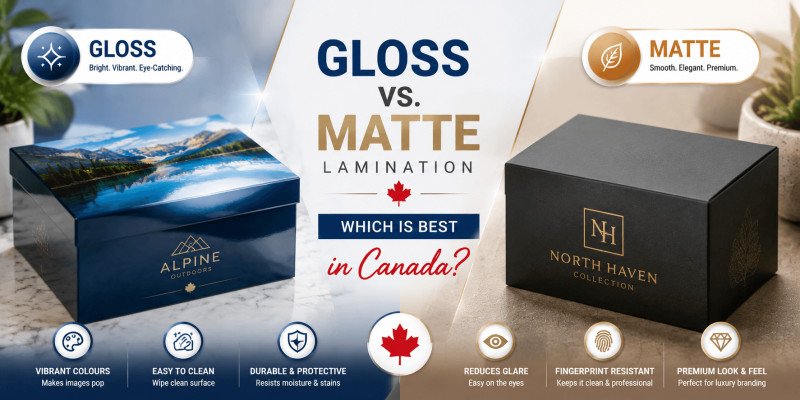
Gloss lamination provides a bright, reflective surface that enhances colours and creates a strong visual impact. It is commonly used for materials where images and vibrant designs need to stand out.
Matte lamination, on the other hand, creates a smooth, non-reflective finish that gives printed materials a sophisticated and premium appearance. It is often preferred by businesses that want a more elegant and professional brand image.
But which one is actually better in Canada?
The answer depends on your industry, your audience, and how your printed materials will be used.
In this guide, we will compare gloss and matte lamination in detail, including appearance, durability, cost, business applications, and which option makes the most sense for Canadian businesses.
What Is Lamination and Why Do Businesses Use It?
Lamination is a finishing process where a thin protective film is applied over printed material. This additional layer protects the paper from everyday damage while improving its overall appearance.
Without lamination, printed materials can quickly lose their quality. Paper can absorb moisture, colours can fade, and frequent handling can cause scratches, stains, and worn edges.
For businesses, lamination provides two major benefits:
First, it increases the lifespan of printed materials. A laminated menu can survive months of customer handling, while a laminated business card can maintain its professional look even after being carried in a wallet or card holder.
Second, lamination improves the customer experience. The texture and finish of printed materials influence how people perceive a brand. A soft matte business card may feel more luxurious, while a glossy brochure with bright images may immediately capture attention.
In Canada, lamination is widely used across many industries, including:
- Restaurants and cafés
- Retail stores
- Real estate companies
- Healthcare clinics
- Corporate offices
- Schools and training centres
- Tourism businesses
- Product manufacturers
However, choosing the wrong finish can affect readability, appearance, and even how customers interact with your materials.
Gloss Lamination: A Bright and Attention-Grabbing Finish
Gloss lamination is one of the most popular finishing options used in commercial printing. It creates a smooth, shiny surface that reflects light and makes colours appear more vibrant.
When a printed image is covered with gloss lamination, the colours usually look deeper and more intense. Photographs appear sharper, graphics become more noticeable, and promotional materials often feel more energetic.
This is why gloss lamination is frequently chosen for marketing materials where businesses want immediate visual impact.
A travel company promoting Canadian destinations, for example, may choose gloss lamination for brochures featuring mountains, lakes, and outdoor adventures. The reflective finish helps enhance the beauty of photographs and makes the brochure more attractive to potential customers.
Similarly, restaurants often prefer gloss finishes because food images look brighter and more appealing.
How Does Gloss Lamination Affect Appearance?
The biggest strength of gloss lamination is visual impact.
The shiny surface reflects light, which creates a polished and professional appearance. Colours usually appear richer because the finish increases contrast between different elements of the design.
This makes gloss especially effective when the printed material contains:
- High-quality photographs
- Colourful graphics
- Product images
- Promotional messages
- Brand visuals
However, the reflective surface can also become a disadvantage in certain situations. Under strong lighting, sunlight, or office lights, glare may make text harder to read.
For this reason, gloss is usually better suited for visual-focused materials rather than documents that contain large amounts of text.
Why Canadian Businesses Choose Gloss Lamination
Gloss lamination remains popular among Canadian businesses because it combines appearance with practicality.
One major advantage is its ability to handle frequent use. The smooth surface is easier to wipe clean compared with untreated paper, making it useful in environments where materials are touched regularly.
A restaurant menu is a perfect example.
Menus are handled by many customers every day. They may come into contact with food, drinks, and fingerprints. A gloss laminated menu can usually be cleaned quickly, helping restaurants maintain a professional appearance.
The same applies to:
- Coffee shop menus
- Price lists
- Product information cards
- Promotional displays
- Event materials
For businesses that need attractive materials at a reasonable cost, gloss lamination is often a practical choice.
Best Situations to Use Gloss Lamination
Gloss lamination works particularly well when the goal is to attract attention.
A retail store launching a seasonal promotion may use glossy flyers because the bright finish helps promotional images stand out. A tourism company may use gloss brochures because customers are naturally drawn to colourful destination photos.
It is also a popular choice for businesses that frequently clean or reuse printed materials.
For example, Canadian restaurants, food trucks, and cafés often choose gloss because their menus need to remain durable while still looking appealing.
The finish communicates energy, visibility, and freshness.
Limitations of Gloss Lamination
Although gloss lamination has many benefits, it is not the perfect choice for every business.
The first limitation is glare. Because the surface reflects light, reading detailed information can sometimes become uncomfortable. This is especially noticeable on documents used under bright indoor lighting.
The second issue is fingerprints. Gloss surfaces can show fingerprints and smudges more easily, especially when dark colours are used in the design.
The third consideration is brand perception. While gloss feels modern and eye-catching, some industries require a quieter and more premium appearance. A luxury brand, law firm, or financial company may prefer the sophisticated feel of matte lamination.
Matte Lamination: A Premium and Professional Finish
While gloss lamination focuses on brightness and visual impact, matte lamination creates a more refined and sophisticated appearance. Instead of reflecting light, matte surfaces absorb and scatter light, creating a smooth finish with minimal glare.
This is why matte lamination has become a popular choice among businesses that want their printed materials to feel premium rather than promotional.
When customers hold a matte laminated business card, brochure, or packaging item, the first impression is often different from gloss. The surface feels softer, calmer, and more professional.
For Canadian businesses competing in professional industries, this small detail can influence how customers perceive a brand.
A law firm, financial advisor, luxury real estate company, or healthcare clinic may not want a bright and flashy appearance. Instead, they often prefer a finish that communicates:
- Trust
- Professionalism
- Quality
- Attention to detail
Matte lamination helps create that feeling.
How Does Matte Lamination Look and Feel?
The biggest difference between matte and gloss is how they interact with light.
Gloss surfaces reflect light, creating shine and stronger colour contrast.
Matte surfaces reduce reflection, creating a softer appearance that is easier to view under different lighting conditions.
A matte finish usually provides:
- A smooth, elegant texture
- Reduced glare
- A modern appearance
- A premium touch
- Better readability
For example, imagine two business cards with the same design.
The glossy version may look brighter and more eye-catching.
The matte version may feel more expensive and professional when someone holds it.
Neither is automatically better they communicate different brand messages.
Why Canadian Businesses Choose Matte Lamination
In Canada, many businesses use matte lamination because customers often associate it with quality and professionalism.
A premium finish can make a simple printed item feel more valuable.
For example, a real estate agent handing out a matte laminated presentation folder may create a stronger impression with high-value clients. A consultant giving a matte business card may appear more established and trustworthy.
Matte lamination is especially effective when the goal is not immediate attention but long-term brand recognition.
Best Uses for Matte Lamination in Canada
Business Cards
Business cards are one of the most common applications for matte lamination.
A business card is often the first physical interaction a customer has with a company. The texture and appearance can influence how memorable that interaction becomes.
Matte business cards work especially well for:
- Consultants
- Lawyers
- Accountants
- Marketing agencies
- Designers
- Corporate professionals
The non-reflective surface also makes text easier to read because there is less glare.
Real Estate Marketing Materials
Real estate is a highly competitive industry in Canada. Agents often use brochures, property guides, and presentation folders to create a premium experience.
Matte lamination works well because it gives marketing materials a luxury feel.
A high-end property brochure with matte finishing can feel more like a premium magazine rather than a simple advertisement.
Healthcare and Professional Services
Healthcare businesses need materials that appear clean, trustworthy, and professional.
Clinics, dental offices, and wellness brands often benefit from matte finishes because they create a calm and modern appearance.
Materials such as:
- Service brochures
- Appointment cards
- Information guides
- Corporate folders
can look more professional with matte lamination.
Advantages of Matte Lamination
1. Reduces Glare and Improves Readability
One of the biggest advantages of matte lamination is reduced reflection.
This is especially useful in environments with strong lighting.
Examples:
- Office environments
- Trade shows
- Retail stores
- Indoor displays
Customers can read information more comfortably without bright reflections covering the design.
2. Creates a Premium Brand Image
Matte finishes are strongly connected with luxury and professionalism.
Many premium brands use matte packaging because the finish feels more sophisticated.
For businesses, this can help communicate:
- Higher quality
- Better service
- Professional standards
3. Hides Fingerprints Better
Compared with glossy finishes, matte surfaces usually hide fingerprints and minor marks more effectively.
This is useful for materials that customers frequently touch.
Examples:
- Product catalogues
- Corporate brochures
- Presentation folders
However, matte surfaces are not completely scratch-proof and may require care depending on usage.
Limitations of Matte Lamination
Although matte lamination offers many benefits, businesses should also understand its limitations.
1. Colours May Appear Softer
Because matte surfaces reduce reflection, colours may appear slightly less vibrant compared with gloss.
This means businesses that depend heavily on bright photography may prefer gloss.
For example:
A restaurant promoting colourful food photography may get more impact from gloss.
A consulting company promoting professional services may prefer matte.
2. Can Cost More
Matte finishes are sometimes more expensive because they require different materials and finishing processes.
For businesses ordering premium materials, the additional cost may be worthwhile because of the improved brand perception.
3. Not Always Ideal for Heavy-Use Materials
Although matte provides protection, materials that experience extremely frequent handling may benefit from gloss.
For example:
- Restaurant menus
- Outdoor promotional materials
- Frequently cleaned materials
may perform better with gloss.
Gloss vs Matte Lamination: Complete Comparison
| Feature | Gloss Lamination | Matte Lamination |
|---|---|---|
| Appearance | Bright and shiny | Soft and elegant |
| Colour Impact | Stronger colours | More natural colours |
| Reflection | High reflection | Low reflection |
| Reading Comfort | Can create glare | Easier under lighting |
| Brand Style | Modern and energetic | Premium and professional |
| Fingerprints | More visible | Less visible |
| Cleaning | Very easy | Easy but needs care |
| Best For | Marketing materials | Corporate materials |
| Cost | Usually more affordable | Often slightly higher |
Which One Is More Durable in Canada?
Both gloss and matte lamination provide protection against everyday damage, but their strengths are different.
Gloss generally performs better when materials need frequent cleaning and handling. Its smooth surface makes it easier to wipe away moisture, stains, and spills.
This is why gloss is commonly used for restaurant menus, promotional materials, and frequently handled prints.
Matte provides excellent protection but is often selected more for appearance and customer experience. It works best when the printed item needs to communicate quality and professionalism.
For Canadian businesses, the choice should depend on how the material will be used.
A restaurant menu exposed to food and drinks has different requirements from a corporate presentation folder used during client meetings.
Gloss vs Matte Lamination: Which One Should Canadian Businesses Choose?
There is no single winner because both finishes solve different problems.
Choose gloss lamination when your priority is:
- Bright colours
- Strong visual impact
- Easy cleaning
- Frequent handling
- Affordable large-volume printing
Choose matte lamination when your priority is:
- Premium appearance
- Professional branding
- Better readability
- Luxury presentation
- Reduced glare
For most marketing campaigns, gloss remains a practical choice.
For professional brands that want customers to remember quality and trust, matte often creates a stronger impression.
Best Lamination Choice by Industry in Canada
Choosing between gloss and matte lamination becomes easier when you look at how different businesses use printed materials. The best finish is not always the one that looks the most attractive; it is the one that matches your customers, environment, and business goals.
A restaurant, for example, needs a finish that can handle spills and frequent cleaning. A law firm needs something that communicates trust and professionalism. A retail brand may need a finish that makes products visually appealing.
Let’s look at which option works best for different Canadian industries.
Restaurants and Cafés: Gloss Lamination Usually Wins
Restaurants are one of the best examples where practical performance matters more than appearance alone.
Menus are touched hundreds of times every day. They are exposed to:
- Food stains
- Water drops
- Grease
- Frequent cleaning
For this reason, gloss lamination is often the preferred choice for restaurants across Canada.
The shiny coating creates a smooth surface that can easily be wiped clean. It also makes food photography more attractive by increasing colour intensity.
A burger photo, coffee image, or dessert picture usually looks more vibrant on a glossy menu.
However, premium restaurants may choose matte lamination if they want a more elegant dining experience. Fine dining restaurants often focus less on bright colours and more on luxury branding.
Best choice:
- Casual restaurants → Gloss
- Cafés → Gloss
- Fast food businesses → Gloss
- Luxury restaurants → Matte
Real Estate Businesses: Matte Creates a Premium Impression
Real estate is a highly competitive industry where presentation matters.
Agents often use:
- Property brochures
- Listing folders
- Business cards
- Market reports
These materials represent expensive decisions, so the finish should communicate trust and quality.
Matte lamination is often the better choice because it creates a premium magazine-like feel.
A matte property brochure can make high-end homes appear more luxurious and professional.
For example, a Toronto or Vancouver real estate agent marketing million-dollar properties may benefit from matte finishing because it matches the premium expectations of buyers.
Best choice: Matte
Healthcare Clinics: Matte Provides Better Readability
Healthcare businesses need printed materials that feel clean, professional, and easy to read.
Examples include:
- Appointment cards
- Service brochures
- Patient information sheets
- Clinic folders
Because healthcare materials often contain important information, reduced glare is valuable.
Matte lamination allows patients to read information more comfortably under bright indoor lighting.
Dental clinics, medical centres, and wellness businesses often benefit from the calm and professional appearance of matte finishing.
Best choice: Matte
Retail Businesses: Depends on Product Goals
Retail businesses often need printed materials that attract attention.
For products with strong visuals, gloss can create better results.
Examples:
- Product displays
- Promotional cards
- Sale posters
- Seasonal advertisements
Gloss helps colours stand out and encourages customers to notice promotions.
However, premium retail brands may prefer matte packaging and brochures because it creates a higher-end feeling.
Best choice:
- Promotional retail materials → Gloss
- Luxury retail branding → Matte
Corporate Offices and Professional Services
Corporate companies usually focus on trust, reliability, and professionalism.
Businesses such as:
- Accounting firms
- Law offices
- Consulting agencies
- Financial companies
often choose matte lamination.
A matte business card or presentation folder feels more refined and professional compared with a highly reflective gloss finish.
For industries where relationships and trust matter, matte usually creates a stronger impression.
Best choice: Matte
Gloss vs Matte Lamination for Common Printing Products
Business Cards
A business card is often the first physical connection between a customer and a company.
The finish can influence how people remember your brand.
Gloss Business Cards
Advantages:
- Bright colours
- Eye-catching appearance
- Affordable
- Good for creative designs
Best for:
- Photographers
- Designers
- Event companies
- Retail businesses
Matte Business Cards
Advantages:
- Premium feeling
- Professional appearance
- Easier reading
- Less glare
Best for:
- Consultants
- Lawyers
- Executives
- Corporate professionals
Winner for most professional businesses: Matte
Restaurant Menus
For menus, durability is usually the priority.
Gloss lamination performs better because:
- It handles spills
- It is easy to clean
- Food images look better
Matte menus can look elegant but may require more careful maintenance.
Winner: Gloss
Brochures and Flyers
The right choice depends on the purpose.
Gloss works well for:
- Product promotions
- Tourism brochures
- Event advertising
- Sales campaigns
Matte works well for:
- Company profiles
- Educational materials
- Professional services
Winner: Depends on purpose
Packaging Materials
Packaging is about customer perception.
Gloss packaging creates:
- Energy
- Brightness
- Strong shelf appeal
Matte packaging creates:
- Luxury
- Premium quality
- Sophisticated branding
Many premium Canadian brands choose matte because customers associate it with higher value.
Winner: Depends on brand positioning
Lamination Cost in Canada: Is Matte More Expensive?
One common question from Canadian businesses is:
"Does matte lamination cost more than gloss?"
In many cases, gloss lamination is slightly more affordable because it is widely used and available for high-volume printing.
Matte lamination may cost more because:
- The material is more specialised
- Production processes can vary
- It is often used for premium printing
However, the price difference is usually not the biggest factor.
Businesses should consider the return on investment.
For example:
A restaurant printing thousands of menus may prioritise affordable durability.
A luxury brand printing premium packaging may consider matte worth the additional cost because it improves customer perception.
The final price depends on:
- Print quantity
- Paper thickness
- Size
- Single or double-sided lamination
- Printing company
- Custom finishes
Canadian Weather Considerations: Which Lamination Handles Canada Better?
Canada has different weather conditions depending on the region.
Businesses may deal with:
- Rain in Vancouver
- Snow and freezing temperatures in Alberta
- Humidity in Ontario
- Seasonal temperature changes across the country
Lamination helps protect printed materials from moisture and daily wear.
For outdoor or frequently handled materials, gloss often provides practical advantages because the smooth surface is easier to clean.
For indoor professional materials, matte remains a strong choice because appearance and readability are usually more important.
Examples:
A restaurant patio menu in Vancouver may benefit from gloss.
A corporate presentation folder in Toronto may benefit from matte.
Gloss vs Matte vs Soft Touch Lamination
Besides gloss and matte, some businesses also consider soft-touch lamination.
Soft-touch is similar to matte but provides a smoother, velvet-like texture.
It is often used for:
- Luxury packaging
- Premium business cards
- High-end brochures
Comparison:
| Finish | Best For | Main Benefit |
|---|---|---|
| Gloss | Marketing materials | Bright colours |
| Matte | Professional brands | Premium appearance |
| Soft Touch | Luxury products | High-end feel |
Soft touch is usually more expensive, so it is best reserved for materials where brand perception is extremely important.
Common Mistakes Businesses Make When Choosing Lamination
Many businesses choose finishes based only on appearance and ignore practical use.
Here are common mistakes:
Choosing Gloss for Text-Heavy Materials
Gloss may look attractive but can create glare that affects readability.
Choosing Matte for Materials That Need Frequent Cleaning
Matte looks premium but may not be ideal for heavily used menus or outdoor materials.
Ignoring Brand Personality
A playful retail brand and a professional consulting company should not necessarily use the same finish.
Focusing Only on Price
The cheapest option is not always the best value. The right finish can improve customer perception and extend product life.
Final Recommendation: Which Lamination Is Best in Canada?
Choose gloss lamination if you need:
- Strong colours
- Easy cleaning
- Marketing impact
- Affordable large-volume printing
Choose matte lamination if you need:
- Professional appearance
- Premium branding
- Better readability
- Luxury presentation
For Canadian restaurants, retail promotions, and visual marketing materials, gloss is often the practical winner.
For corporate businesses, healthcare providers, real estate professionals, and premium brands, matte usually creates a stronger impression.
The smartest approach is to choose the finish based on how customers will interact with your printed materials, not just how it looks on the first day.