


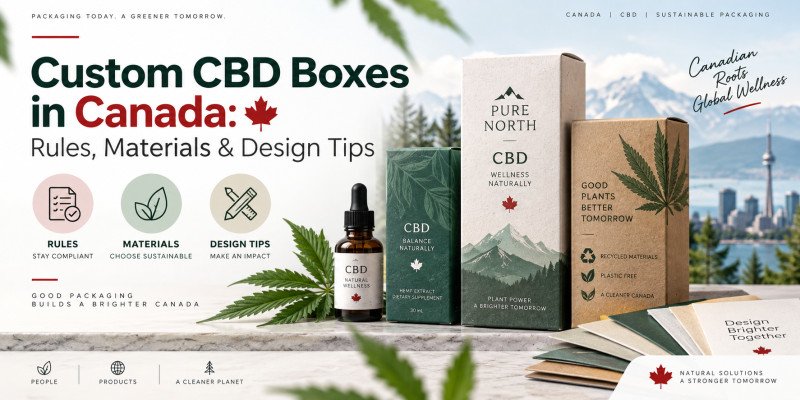
If you're planning custom CBD boxes for the Canadian market, start with this: most of the CBD packaging you see online wasn't designed for Canada. Bright gradients, gold foil logos, holographic sleeves, and "wellness benefit" claims are everywhere on US packaging. In Canada, the same design can make your product unsellable.
That's because Canada regulates CBD differently. Your box has to meet Health Canada's plain-packaging rules before it can do anything else. Compliant packaging doesn't have to look cheap, though. With the right materials, structure, and print quality, a plain-packaging box can still look premium and be instantly recognizable on the shelf.
This guide covers the rules that apply to CBD packaging in Canada, what must appear on your label, which materials and box styles work best, and how to build a brand within the limits.
Key takeaways:
- CBD in Canada falls under the Cannabis Act, so cannabis plain-packaging rules apply.
- Boxes must use one uniform color and smooth surfaces. Foil, embossing, metallic inks, and fluorescent inks aren't allowed.
- Labels need a white background, black sans-serif text, a yellow health warning box, and in most cases the standardized cannabis symbol.
- Your brand can stand out through box structure, material quality, one signature color, and inserts.
Is CBD treated as cannabis in Canada?
Yes. In Canada, CBD is not treated as a distinct substance from cannabis. Whether your CBD is derived from hemp or marijuana, it falls under the Cannabis Act framework if it meets the legislative definition of cannabis.
This is the biggest difference from markets where hemp-derived CBD can be sold like a supplement. In Canada, legal CBD products are produced by federal licence holders and sold through provincially authorized retailers. Every package has to meet the same packaging and labeling rules as any other cannabis product.
It's also important to know who carries the responsibility. Licence holders are responsible for complying with the Act and its regulations, and Health Canada does not review or pre-approve packages and labels of cannabis products. There's no approval stamp to rely on. Your licence holder, designer, and packaging supplier need to work from the same rulebook from the start.
One rule catches many brands moving over from the US: it is prohibited to make an express or implied representation, including by way of a brand element, that could create the impression that health or cosmetic benefits may be derived from the use of the cannabis product. Phrases like "relieves stress," "anti-aging," or "for better sleep" don't belong on a Canadian CBD box.
How Plain-Packaging Rules Shape Your Box Design
Health Canada's rules exist to make cannabis products less appealing to young people and to make safety information stand out. The scope is broad: plain packaging and labeling apply to all surfaces, including labels and the various types and parts of the package, such as containers, wrappers, and coverings, but do not apply to inserts or leaflets and peel-back or accordion panels.
Here's how that affects each part of your box design.
One uniform color
The color of the interior surface, exterior surface, and panel of any container in which a cannabis product is packaged must be one uniform color fluorescent for containers or wrappers, or metallic colors on containers. The color you pick must also create a contrast with the yellow colour of the health warning message and the red color of the standardised cannabis symbol.
There is a little flexibility. The color of the container may differ from the color of the lid or cap. Health Canada also notes that colors that have the lustre of metal include Pantone Metallics or Pantone Premium Metallics, and fluorescent properties include pigments such as the Pantone 800 series. Tell your printer up front so these inks are never specified.
Smooth surfaces only
Texture is restricted too. The guide calls for no raised features for containers and coverings, no embossing or decorative ridges for wrappers, and no other irregularities such as engravings or etchings. The exception does not apply to features necessary to facilitate opening and closing of the container and those to assist persons who are visually impaired.
For box design, this rules out embossing, debossing, raised spot UV, and textured paper wraps.
No hidden or interactive features
Packaging can't include heat-activated ink or a feature that is visible only through technological means, unless it is a bar code or used to prevent counterfeiting. It also can't have features that can change surface area, including tags or fold-out panels, except peel-back or accordion panels for an immediate container, and it must not emit scent or sound.
Windows
Window boxes are popular in retail packaging, but for most CBD products they aren't an option. Cut-out windows are prohibited, and the exception does not apply to coverings, wrappers, or any container in which dried cannabis, fresh cannabis, or cannabis plant seeds are packaged. CBD oils, capsules, topicals, and edibles fall under the main rule, so no windows. The immediate container for these products must also be opaque or translucent.
Brand elements
Your brand name is required, but other branding is limited. Packaging may have no brand element on the interior or exterior surfaces of a container or a wrapper nor on a covering, with an exception made to allow one brand element on a label.
Size rules apply too. If the brand element is an image or graphic, the surface area must be smaller than or equal to the surface area of the standardised cannabis symbol that appears on the label. Many CBD-dominant products have more room: for cannabis products containing less than 10 μg/g THC, which are not required to display the standardised cannabis symbol, the brand element, if an image, must be smaller than or equal to 25% of the principal display panel of the label and smaller than or equal to the surface area of the health warning message.
Quick reference: allowed vs. not allowed
| Allowed on Canadian CBD Boxes | Not Allowed |
|---|---|
| One uniform, non-metallic color | Gradients, patterns, multiple colors |
| Smooth matte surface | Embossing, debossing, raised spot UV |
| Brand name plus one brand element on the label | Logos repeated across box panels |
| Up to 2 black-and-white barcodes or QR codes | Foil stamping, holographic, or metallic inks |
| Inserts and leaflets | Windows (for oils, capsules, topicals, and edibles) |
| Peel-back or accordion panels on the immediate container | Scented coatings, sound chips, fold-out tags |
What Must Appear on Your CBD Box Label
Canadian cannabis labels follow a strict format. All information on the label must be in English and French, and other than the brand name, the standardised cannabis symbol, and the health warning message, the required information must use a white background, black type, regular weight and width, standard sans serif without italics, and at a type size of at least 6 points.
Your label must include:
- Standardised cannabis symbol: required on all cannabis products containing THC in a concentration greater than 10 μg/g, at a minimum size of 1.27 cm by 1.27 cm, in the upper left 25% of the principal display panel.
- Health warning message: shown in a yellow box. The messages must be displayed in rotation on each type of container of each brand name of the cannabis product that is packaged in a year.
- THC and CBD content: total THC and CBD content must be displayed in bold type, at least 6 points away from any other information.
- Brand name: must not be in metallic or fluorescent colours.
- Licence holder details: name, phone number, and email address.
- Product details: class of cannabis, lot number, recommended storage conditions, packaging date, and net weight.
- Unit information: number of discrete units and weight per unit, if applicable (for example, capsules).
- Warning statement: "KEEP OUT OF REACH OF CHILDREN / TENIR HORS DE LA PORTÉE DES ENFANTS" in upper-case font.
- Extracts and topicals: common name, intended use, and a full ingredient list. Extracts must also list food allergens.
Design tip: Lay out the mandatory information first, then fit your brand into the space that's left. Designing the brand first and squeezing the rules in afterward is the most common reason Canadian CBD boxes need a costly reprint. For help with French text, see our Bilingual Packaging in Canada guide.
The Three Packaging Layers: Container, Box, and Shipper
CBD packaging usually has up to three layers, and each has different rules.
1. The immediate container. This is the bottle, jar, or blister in direct contact with the product. It must be child resistant, meeting the requirements set out in C.01.001(2) to (4) of the Food and Drugs Regulations, and have a security feature that provides reasonable assurance to consumers that the package has not been opened prior to purchase. For CBD oils, there are size and dosing rules as well: A container of liquid cannabis extract cannot contain more than 90 mL, and liquid extract with greater than 10 mg THC not intended for inhalation must have an integrated dispensing mechanism. Size your custom box to the bottle and dispenser you'll actually use.
2. The outer box (your custom CBD box). This is the printed carton on the retail shelf, and all the plain-packaging rules above apply to it. It doesn't carry the child-resistance requirement: the outermost container does not need to be child resistant. For multi-packs, all outermost labels must indicate the number of immediate containers inside the co-pack, along with lot numbers that trace back to each container.
3. The shipping box. Health Canada's guide does not apply to shipping containers such as outer wrappings or boxes used to transport cannabis products. Corrugated shippers can carry handling and logistics marks. Keep them discreet, and check with your compliance team before adding any branding. See our corrugated mailer boxes for shipping options.
Best Materials for Custom CBD Boxes in Canada
Because plain packaging limits decoration, material quality does more of the work. Buyers judge a brand by how the box feels, how cleanly it's printed, and how it holds up.
- White SBS cardboard: A smooth, bright surface that prints a single uniform color evenly and keeps 6-point bilingual text sharp. It's the top choice for tincture, capsule, and topical cartons.
- Blackboard: Contrasts well with the yellow warning and red symbol and gives a premium look with no decoration at all.
- Kraft board: Suits natural and eco-focused brands. Kraft has visible fiber, so confirm with your compliance team that your chosen stock reads as smooth and uniform.
- Corrugated E-flute: Ideal for co-pack cartons and shippers where strength matters.
- Rigid board: For premium gift sets. Wrap it in smooth paper in one uniform color, and avoid leatherette, velvet, or linen textures.
Finish: Several Canadian compliance guides list no metallic or glossy finishes, embossing, foil, or peel-away labels as part of plain packaging. A smooth matte lamination is the safest choice. It protects the print and reduces glare on mandatory text.
Sustainability: Health Canada supports paper-based packaging. The guide notes that the regulations permit wrappers and peel-back-type labels as well as flexibility for packaging materials other than plastics (for example, cardboard), and Health Canada encourages the use of environmentally sound packaging approaches, provided all requirements are met.
Popular CBD Box Styles
- Tuck-end tincture boxes: The most common style for dropper bottles. Add a paperboard insert to keep the bottle from moving.
- Capsule and softgel cartons: Compact boxes sized to the bottle, with side panels for bilingual information.
- Topical and cream boxes: Cartons for jars and tubes. Our custom oil boxes also work well for bottled CBD products.
- Sleeve and tray boxes: A premium unboxing experience that comes from structure, not decoration.
- Co-pack cartons: Multi-packs of the same product, with label space for container counts and lot numbers.
How to Build a Recognisable CBD Brand in Canada
Plain packaging levels the playing field, so the brands that stand out are the ones that make smart structural and material choices.
1. Own one signature color. Choose one shade that contrasts well with the yellow warning and red symbol, and use it across every product. Shoppers will learn to spot your color from across the store. Your lid or cap can be a second color, since the rules allow it.
2. Invest in structure. A sleeve-and-tray box, a well-fitted insert, or a satisfying tuck closure makes a product feel premium without breaking any finish rules.
3. Use inserts. Inserts are your biggest creative opportunity. Inserts or leaflets do not have restrictions on font type, font size, the inclusion of images, or color, and they are not limited in the number or dimension of brand elements they can contain. You can share your brand story or production details, such as "sun grown", "hand trimmed", "woman owned", or "family owned". Inserts still must be bilingual and follow the Act's rules on youth appeal and health claims.
4. Use QR codes wisely. Up to 2 bar codes, including QR codes, may be displayed on any container, each printed in black and white. Link to your certificate of analysis or terpene profile. Remember that all material accessible through the QR code is subject to the requirements of the Act and its regulations, including restrictions on the promotion of cannabis.
5. Stay consistent. Keep panel layouts, typography, and box proportions identical across your range so your products look like one family on the shelf.
Common Mistakes Canadian CBD Brands Make
- Reusing US packaging designs with foil, holographic, or metallic finishes
- Printing health or wellness claims on the box
- Printing English-only labels
- Adding a window to an oil or capsule box
- Printing logos on several panels instead of one brand element on the label
- Keeping old labels that are missing the health warnings
- Sizing the box before choosing the final child-resistant bottle
Pre-Print Checklist
Before you approve your proof, confirm that:
- The box uses one uniform color with no metallic or fluorescent inks
- Surfaces are smooth, with no embossing, foil, or raised coatings
- All mandatory information appears in English and French
- The cannabis symbol (if required) sits in the upper-left 25% of the principal display panel
- The health warning uses the current approved wording
- Total THC and CBD values are bold and properly spaced
- Your licence holder has reviewed and signed off on the final artwork
Order Compliant Custom CBD Boxes in Canada
At CustomBoxesZone Canada, we build custom CBD boxes around Health Canada's plain-packaging rules, not generic retail templates. You get smooth, single-color printing on premium board, sizes matched to your child-resistant containers, and panel layouts that leave the right space for bilingual mandatory information. Every order includes free design support and a digital proof before production.
Send us your container dimensions, product class, and label content, and we will send a free quote with a mockup. Final label content should always be confirmed by your licence holder or compliance advisor.