


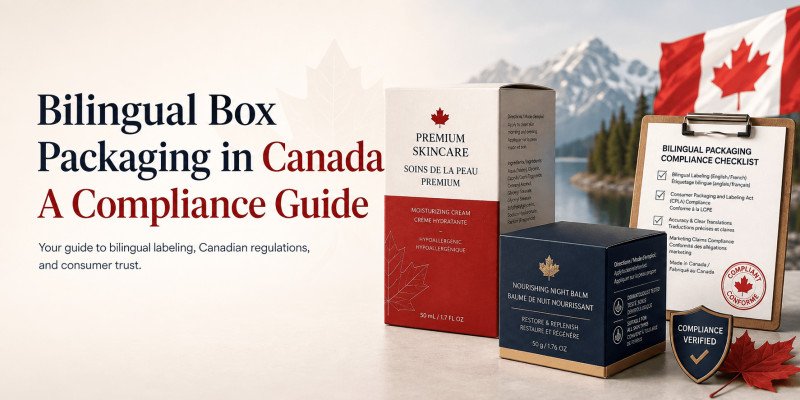
Selling a product in Canada means meeting a labelling standard that catches many brands off guard: your box almost always has to speak two languages. Bilingual box packaging isn't optional or a Quebec-only concern it's a federal legal requirement across the country, and it shapes everything from the words on your box to the panel space your design needs. For any brand entering the Canadian market, or any Canadian brand scaling up, understanding bilingual packaging rules is the difference between a smooth launch and a shipment held at the border or pulled from a retailer's shelf.
This guide covers everything about bilingual box packaging in Canada from a packaging perspective: what the law requires, what must appear in both languages, the exceptions, Quebec's tougher rules, the most common mistakes that trigger reprints, and how to design custom boxes that meet the requirement without sacrificing your branding. It's written for brand owners, e-commerce sellers, importers, and small businesses ordering custom packaging, product boxes, or printed boxes who need to get their packaging right the first time.
What Is Bilingual Box Packaging in Canada?
Bilingual box packaging in Canada means product packaging that displays mandatory label information in both of Canada's official languages English and French. It's required under federal law for most prepackaged consumer products, so that both English-speaking and French-speaking consumers have equal access to the information they need to make a purchase.
The core principle is simple: any information the law requires on a label must appear in both languages, and it must be equally prominent in each. A brand can't print the English in large type and tuck the French into tiny text in a corner. Both languages carry equal legal weight, which is why bilingual box packaging affects not just translation but the physical design and size of the box itself.
Bilingual packaging is regulated mainly through the Consumer Packaging and Labelling Act (CPLA) and its regulations, enforced federally, with additional layers for specific product categories like food, cosmetics, and drugs. For a packaging buyer, the practical takeaway is clear: your custom box has to carry roughly twice the mandatory copy of a single-language product, and it has to carry it legibly. Whether it's a folding carton, a rigid box, a mailer box, or a kraft box, that reality needs to be planned into the box from the beginning, not squeezed in at the proof stage.
Why Does Canada Require Bilingual Packaging?
Canada is officially bilingual, and its packaging laws reflect that. The purpose of bilingual box packaging is to give French-speaking and English-speaking consumers equal access to product information identity, quantity, safety warnings, and directions regardless of which language they speak. It's consumer protection and linguistic equality written into federal law.
For businesses, bilingual packaging is more than a legal box to tick it's a condition of market access. Products with non-compliant packaging can be refused entry, held by customs, removed from retail shelves, or delisted from marketplaces like Amazon Canada, which requires bilingual labelling for products sold on its Canadian store. Non-compliance can also carry financial penalties. So bilingual box packaging is best understood not as red tape but as the entry fee for selling in one of North America's major markets and brands that treat it as a design consideration from the start avoid the expensive problems that come from treating it as an afterthought.
There's a commercial upside too. Well-executed bilingual box packaging signals to Canadian consumers especially in Quebec and other French-speaking regions that a brand respects and includes them. Custom packaging that reads naturally in both languages builds trust and widens a product's appeal across the whole country rather than half of it.
What Information Must Appear in Both Languages?
Not every word on a box has to be bilingual, but the mandatory information does. Under the Consumer Packaging and Labelling Act and its regulations, the following must generally appear in both English and French on prepackaged consumer products.
Product identity. The common name or description of what the product is must be shown in both official languages on the principal display panel the main face of the box the consumer sees. A few product-identity terms are considered bilingual in themselves, but most require both languages.
Net quantity. The amount of product in the package must be declared in both languages and, crucially, in metric units, since Canada uses the metric system. Even the unit words can require translation "grams" becomes "grammes" in French and the declaration must meet specific rules for placement and type size.
Mandatory warnings and cautionary statements. Any required safety warning, caution, or handling statement must appear in both languages. For certain products, specific critical statements must always be bilingual regardless of context.
Directions for use. Where directions are required, they generally must be provided in both English and French so all consumers can use the product safely and correctly.
The one significant exception is the dealer's identity the name and principal place of business of the company that manufactured, processed, or packaged the product for resale. This may be shown in only one of the official languages, and a company name and address are typically not translated at all, appearing once rather than duplicated.
For a box design, this means your custom packaging must carry bilingual product identity, net quantity, warnings, and directions, while the brand's own name and address can sit in a single language. Knowing which elements double and which don't is the foundation of laying out compliant bilingual box packaging.
The Metric and Equal-Prominence Rules
Two rules trip up brands more than any others when it comes to bilingual box packaging, and both affect the box design directly.
The first is the metric requirement. Net quantity on Canadian packaging must be declared in metric units (grams, millilitres, litres) displayed correctly and legibly. Numbers themselves are considered bilingual (a "5" reads the same in both languages), but the unit words and the way the quantity is presented must follow the regulations. A US-market box that lists only ounces or pounds won't comply in Canada.
The second is equal prominence. The English and French versions of mandatory information must be displayed with equal prominence, the same size, clarity, and visibility. Neither language can be visually subordinate to the other. This is a design constraint as much as a legal one: it means your printed boxes have to give both languages room to breathe at a readable size, which is why bilingual box packaging almost always needs more panel space than a single-language equivalent.
Together, these two rules explain why bilingual packaging can't simply be "added on." A custom box designed for a single market and then retrofitted with a second language usually ends up with cramped, illegible type or a quantity declaration in the wrong units both of which are compliance failures.
Quebec: Stricter French-First Rules
Federal bilingual packaging rules apply across all of Canada, but Quebec adds a further layer that brands must plan for. Under Quebec's language legislation, including the Charter of the French Language and its recent strengthening under Bill 96, French holds a privileged position. For products sold in Quebec, French must be present and, in many cases, at least as prominent as any other language, with requirements tightening over time.
The practical implication for box packaging is that a design which merely includes French alongside English may satisfy the federal baseline but still fall short of Quebec's expectations. Brands selling nationally often design their bilingual box packaging to Quebec's stricter standard from the outset, since custom boxes that satisfy Quebec will satisfy the rest of the country but not necessarily the reverse. It's also important to use Canadian French, not European French, because certain terms differ and using the wrong regional wording can cause confusion or non-compliance.
For any brand with national ambitions, the safest approach is to treat Quebec's requirements as the design target for your bilingual packaging, ensuring French is fully present, correctly worded, and prominent.
Which Products Need Bilingual Box Packaging?
Most prepackaged consumer products sold at retail in Canada require bilingual box packaging, but the exact rules and governing legislation vary by category. Understanding where your product falls helps you plan the right box.
General consumer goods cosmetic boxes, custom product boxes, and retail packaging for household and non-food items fall under the Consumer Packaging and Labelling Act, which sets the core bilingual packaging requirements.
Food products need food-grade boxes and food packaging governed additionally by the Food and Drugs Act and the Safe Food for Canadians Regulations, enforced by the Canadian Food Inspection Agency. Food packaging carries some of the strictest bilingual requirements identity, net quantity, ingredient lists, nutrition information, and mandatory statements and bilingual labelling is one of the most common areas of food-packaging non-compliance.
Cosmetics sold in custom cosmetic boxes must show ingredient lists using INCI nomenclature and provide mandatory information bilingually, though INCI ingredient names themselves are treated as universal and generally don't require translation.
Drugs and medical devices in their medicine and pharmaceutical packaging are covered by the Food and Drug Regulations, with their own bilingual labelling requirements distinct from the CPLA.
There are exceptions. Shipping containers and bulk packaging including corrugated boxes and shipping boxes for industrial or institutional use, not sold directly to consumers are generally exempt from bilingual retail labelling, though certain critical safety statements can still be required in both languages. And qualifying test-market products may be temporarily exempt from full bilingual box packaging for a limited period under specific conditions, giving new products a window to test the market before committing to full bilingual production.
For most brands, the rule of thumb is simple: if the product is prepackaged and sold to consumers at retail in Canada, plan for bilingual box packaging.
How Bilingual Requirements Change Your Box Design
This is where bilingual box packaging becomes a custom box problem rather than just a translation task, and it's the part brands most often underestimate.
French takes more space. French text is frequently longer than its English equivalent sometimes markedly so. A phrase that fits comfortably in English can run significantly longer in French, so the box needs more panel area, a larger format, or a carefully managed layout to fit both languages at a legible, equally prominent size. A custom box designed tightly around English copy alone simply won't have room for the French.
Panel hierarchy matters. With roughly double the mandatory copy, the layout has to be planned so that product identity, net quantity, warnings, and directions all appear in both languages without the design becoming cluttered or the type shrinking below legibility. On small custom boxes a compact cosmetic carton, a small food box, a slim soap box this is a genuine geometry challenge that must be solved at the dieline stage, before artwork is finalized. Larger formats like rigid boxes and mailer boxes give more room, but the layout still has to be planned.
Legibility is non-negotiable. Both languages must be readable. Squeezing French into a tiny font to make it fit is a common failure that renders the packaging non-compliant even though the words are technically present. The box has to be sized so both languages sit at a legible point size.
Design early, not late. The most expensive mistake in bilingual box packaging is treating the French as something to add after the English design is locked. By then the panels are full, and the only options are shrinking type below legibility or reprinting at a larger size. Compliant custom packaging starts with a box and layout built for two languages from the first draft.
This is exactly why bilingual box packaging is a structural decision, not just a copy decision. The box size, the panel layout, and the type hierarchy all have to be planned around carrying two languages legibly whether you're ordering folding cartons, printed boxes, or rigid gift boxes.
Common Bilingual Packaging Mistakes That Cause Reprints
A reprint is the single most expensive event in a packaging order, and bilingual box packaging is one of the most common triggers. The recurring mistakes are predictable and avoidable.
Missing or incomplete French. Leaving required information in English only, or translating some elements but not others, is the most frequent failure. Every mandatory element on your custom boxes must be bilingual.
Illegible French type. Shrinking the French to fit a box designed for English breaks the equal-prominence rule and fails inspection even though the words are there.
Wrong units. Declaring net quantity in imperial units, or omitting the metric declaration, is a straightforward non-compliance that's easy to miss on a US-designed box.
Outdated or European French. Using European French wording instead of Canadian French, or outdated terminology, can cause confusion and non-compliance, particularly in Quebec.
Retrofitting a single-language box. Trying to add French to custom packaging designed only for English almost always ends in cramped, non-compliant boxes and a reprint. Designing bilingually from the start avoids it entirely.
Ignoring Quebec. Meeting the federal baseline but not Quebec's stricter French-first rules can still cause problems in that market. Designing to Quebec's standard covers the whole country.
Each of these means a reprint, a delay, and lost shelf time and each is preventable when your bilingual box packaging is designed correctly the first time.
How to Get Your Bilingual Box Packaging Right
Getting bilingual box packaging right comes down to planning it as a design requirement, not a translation errand. A few practical steps make the difference.
Start by identifying every mandatory element for your product category product identity, net quantity, warnings and directions, and confirm which must be bilingual and which (like the dealer name) can be single-language. Then have the copy professionally translated into Canadian French, since accuracy and regional wording matter. Design the box around both languages from the first dieline, giving the French room to sit at equal prominence and legible size, and design to Quebec's stricter standard if you sell nationally. Finally, review the layout against the requirements before printing, checking bilingual completeness, metric units, and legibility so nothing surfaces after the box is on press.
A custom box manufacturer or packaging supplier who lays out bilingual and compliance panels at the dieline stage, rather than retrofitting them at proof, removes most of the risk. Whether you're ordering printed boxes, custom cardboard boxes, or wholesale packaging, the box can be built to make that compliance straightforward rather than a scramble. The compliance itself, verifying the final label against the law and handling any product notification, remains the brand's responsibility, but the packaging can be built to support it rather than fight it.
Bilingual Packaging as a Market Advantage
It's easy to see bilingual box packaging purely as a legal hurdle, but the brands that do it well treat it as an advantage. Custom packaging that reads naturally and respectfully in both English and French opens a product to the entire Canadian market rather than a portion of it, and it signals inclusion to French-speaking consumers who notice when a brand gets it right and when it doesn't. In a competitive market, thoughtful bilingual boxes are a quiet trust-builder that widens reach and reputation at the same time.
For any brand serious about Canada, then, bilingual custom packaging is worth designing well from the start not just to satisfy the law, but to compete for every Canadian customer. Getting your custom boxes right in both languages is one of the simplest ways to look like a national brand from day one.
Get Bilingual-Ready Boxes for the Canadian Market
Need packaging that's compliant from the first print run? CustomBoxesZone Canada designs and manufactures custom boxes, cosmetic boxes, food boxes, bottle boxes, and rigid gift boxes with bilingual English/French panels laid out at the dieline stage so your custom packaging is both compliant and premium without the reprints. With a low 50-unit minimum, free design and 3D proofing, and free Canada-wide delivery, you get wholesale packaging that meets Canadian law and looks the part on the shelf. Request a free quote today.